Saturday, March 1, 2014

Cheating vs. Helping


The fine line between cheating and helping is considered a cultural shock.  Depending on the perspective in which is considered.  For example, in the United States, the act of helping another student during a test is considered cheating, a bad thing.  In contrast in Puerto Rico there is a debate in whether helping is considered cheating a bad thing or it is permissible under the educational standards as it can be considered a means or alternative result in obtaining knowledge.  What causes the cultural shock? Well, in the United States students are taught to compete in all aspects of life.  They are in a constant race to be best not only at their class, but with others schools.  This indeed promotes a view that ‘helping ‘another student is bad, therefore cheating or just a mean of using the easy way out.   In Puerto Rico, helping others it is a principle that is taught since childhood and it’s a part of our cultural background.  Puerto Ricans cannot help themselves from helping others especially when it comes to an exam.  Students like to cheat, because they want their friends to pass as much as they do. 
Jim Cooper’s chapter eight “Helping” exposes the reality of students in Puerto Rico ‘helping’ each other during exams, which he considered was cheating.  The problem he faced was that he had no trouble with the students helping each other during class, but not during exams.  Coopers posture was that an exam is an auto-evaluation that is strictly personal.  But after a conversation with another puertorican English teacher, who told him that he did not care if their students cheat, because his main interest is that their students learn the right answers to the questions.  In other word to obtain the knowledge he had intended for them.  So that’s why cheating in Puerto Rican students is not that of a bad thing. 


Teaching English, Perspective View in the 1950's and Present.

Human beings are capable of communicating information as a source of knowledge through language.   This permits exchange of information for the construction, through the concepts created by ourselves.  Teaching is the method in which information is transmitted to one human being to another, in this case many, a classroom.  In Jim Cooper’s, “Down on the Island” he describes his personal experience in teaching in the University of Puerto Rico, Mayaguez campus, during late 1940’s and 1950’s.  By that period of time, Puerto Rico was going through major political and economical changes that affected the system of education.  As a teacher he followed the syllabus that the department of English of the University of Puerto Rico, Mayaguez campus had established and he noticed that it was not effective.  Cooper had a certain responsibility to change the system in a way that the students in Puerto Rico could learn the second language, which is English. 
‘’I realized the enormity of the dream world or wish-fulfillment world I was walking into”.(p.68)
He noticed that the students that came out of high school, especially public school did not pose the skills to understand the English language in the materials that were given to them.  There were no language skills and on top of that, the government was not aware of the reality of the mechanism of learning another language successfully as they hope they will.  This chapter represents the historical reality of Puerto Rico in the 1950’s.  Cooper lived to see and collide with this reality.  He had a unique personal experience during these extreme changes in the life in Puerto Rico, and discovered the truth that the students had the right to learn English by other systems according to their needs.
The discrepancy of the education system still continues today and it still demonstrates that does not prepare the students to be fluent in a second language, in our case English.  This is a consequence from a political decision made in the 1950’s that had caused that most of Puerto Ricans still have the problem of not dominating the skills to speak and write properly in English, thus not being to duly bilingual.


Sunday, February 16, 2014

"A Small Place" - Innocence of Tourists.

    Jamaica Kincaid's "A Small Place" tends to explain the situation of post-colonial Antigua, her homeland. Between political, cultural and social changes, Antigua has evolved to an island in which not many are aware of its current situation.  "A Small Place" intends to deliver a glimpse of what is Antigua.  It exposes how the tourist is viewed by the locals, also themes and arguments that are of significant to the residents and play part of the history of the island.  In this post I will write about the innocence of the tourist versus the perspective of the local, based on the novel and also from my personal experience.

   Is the tourist being just innocent or ignorant?  Innocence is defined as the lack of knowledge.  But it seems as Kincaid makes it sound like is ignorance, which is another form of lack of knowledge.  The tourists visit Antigua with the expectation of paradise.  They do not know the actual status of the island.  For example, they are not fully aware of the currency. The tourist may be  familiar with the exchange rate, but the locals are the ones responsible for the services.  The tourist may be innocent in the way that they are not familiar with the currency.  Tourist may not be aware that fluctuation on currency can be based on the needs of the local providing the service.  For example, taxi rates can change from one taxi to another.  They come to visit and escape their world and they are willing to pay these differences. 

   In many tropical islands that depend on tourism as Kincaid may state: " A tourist is an ugly human being".  They are a sort of invaders, nevertheless they are part of their economy.  They are ugly because they are ignorant, they do not have knowledge of their culture.  As for example the water quality in the island.  Antigua does not have a fresh water resources, but they distill saltwater so it is of a different quality and besides have a lower water pressure.  They constantly complain about how does the water taste and its pressure, and they do not understand the situation that is going in the island.  This is something they encounter when they arrive at the island and can be considered as ignorance.

   As a local in a Island (Puerto Rico), I can say that I have encountered both innocent and ignorant tourists.  I work daily with tourist from around the world serving them coffee.  My perspective as a local is that a tourist is getting away from their daily routine.  We, the locals that deal directly with the tourist have a privilege position as we are responsible for educating them and teaching them about our lifestyle and culture.  I feel that my job provides me with a satisfaction of informing the common tourist, thus having the opportunity to have an enriched cultural exchange. 
   

Etherwood - Falling Out Of Consciousness (feat. Georgia Yates and Bev Le...

Etherwood - The Time is Here At Last (feat. Hybrid Minds)


Shot entirely on a GoPro across China, Laos, Thailand & Cambodia, throughout Summer 2013.


Etherwood - Weightless - Official Video


Let me take you in a trip around the world via youtube,  This video was shot entirely on a GoPro camera across China, Laos, Thailand & Cambidia in the Summer 2013. Filmed by Max Palmer.

The song is called Weightless by Etherwood, an upcoming artists in the Drum and Bass scene.  


Wednesday, January 29, 2014

Insight about me.


My name is Sylvette García, I am a student in the University of Puerto Rico, Río Piedras campus.
I'm currently getting my major in Cellular Molecular Biology in Natural Science.  I'm really passionate of what I am studying and plan to pursue my future in this area of study.  I always find myself on the move searching for new places.  Let me share with you guys a little insight of who I am.  I like to visit new places, especially here in Puerto Rico, in which sometimes us locals underestimate its beauty.  I enjoy of late night running, skating, bike rides, coffee, music, and going to the beach.  Also I have a passion for ballet dancing and arts.

Let me take you in a journey of my previous trips.  The following list exposes the top 10 places that I had visited during my life. I only have been on a plane once and was to DisneyWorld, my other trips are basically road trips around the island.
1.    Culebra- Flamenco Beach
2.    Isabela, PR- Jobos Beach
3.    Isabela, PR- Middles Beach
4.    Cueva Ventana- Arecibo, PR.
5.    Cueva del Indio- Arecido,PR.
6.    Cavernas de Camuy- Camuy, PR.
7.    Icacos Island.
8.    Mata la Gata.
9.    Disney World
10. Gozalandia- San Sebastian, PR.

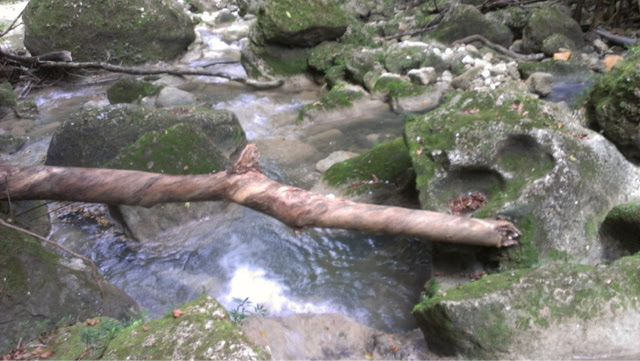
Most of my trips are road trips right here in my homeland Puerto Rico.  One of my best experiences was visiting Gozalandia in San Sebastian, PR.  This is a hot spot for tourist and specially locals.  It’s a river with natural cascades and a lot nature. 
During my trip, my friends and I were amazed of the beauty this place beholds.  In one of the rivers there was this man, a local, which gave us a mini tour.  He shows us the underwater caves and told us some awesome stories.  Also we jump into the river with a rope.  Our identity as locals was questioned with the local man, but when we offered him some 'quenepas' he knew we were from the island.  Its interesting the fact that many locals are 'turist' on there own place and that give us a insight of what we are missing in paradise.  Ihope to explore most places right here in Puerto Rico.  Also I want to travel around the world but that’s just a matter of time.